
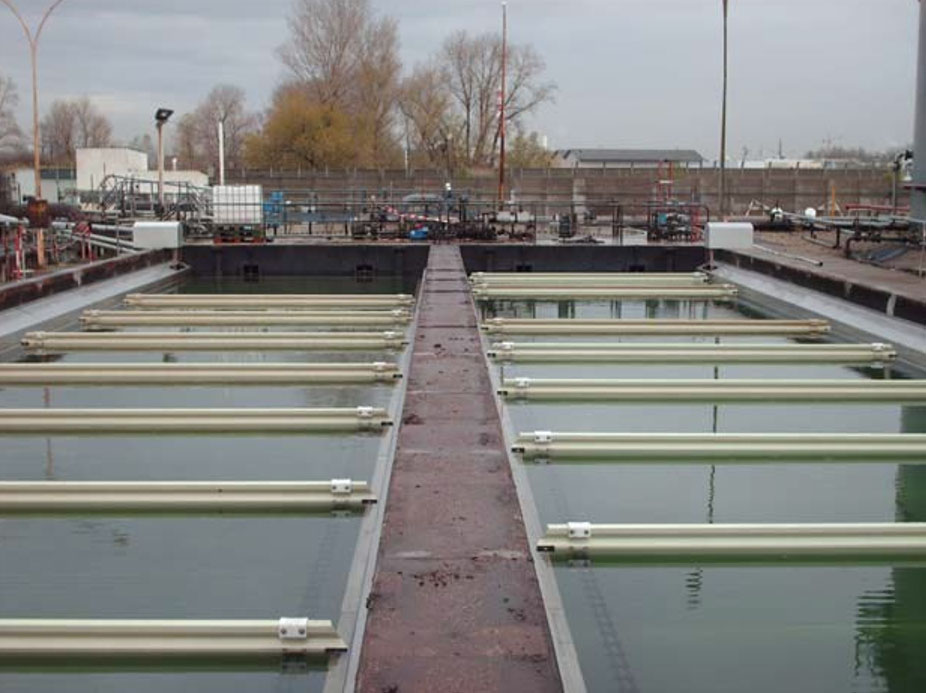
Here is how Indian ETPs get specified. A consultant visits the plant for two hours, looks at the process, and writes a design brief. The brief specifies a 400 m³ biological reactor (₹80 lakh), a DAF unit (₹25 lakh), a secondary clarifier (₹30 lakh), a sludge thickener, a filter press — and a 100 m³ equalization tank with a 4-hour HRT (₹8 lakh). The plant is a batch food manufacturer running three CIP cycles per day with COD swinging from 600 to 7,500 mg/L.
Six months after commissioning, the biological system is crashing regularly. The MLSS keeps dropping after CIP peaks. Outlet BOD is 80-120 mg/L. The consultant recommends increasing the reactor volume. But the reactor is not the problem. A 4-hour equalization tank for a batch process plant is the equivalent of no equalization at all — the COD peaks are passing straight through to the biology. This is the most common and most preventable design error in Indian ETP projects.
Why Equalization Matters: The Numbers
Take a packaged food plant with a nominal flow of 400 KLD. The plant runs two 8-hour production shifts and one CIP shift. During production shifts, COD in the drain is 800-1,200 mg/L — wash water, product residue, moderate load. During the CIP shift, COD spikes to 4,000-8,000 mg/L as concentrated caustic cleaners and rinse water mix.
Without equalization, the MBBR downstream sees a COD load that varies by a factor of 6-8x across the day. A 4-hour equalization tank buffers only the first 4 hours of the CIP cycle before the high-COD water starts flowing out at nearly its full concentration. A 16-hour equalization tank blends the entire 24-hour cycle — the MBBR sees a steady ~2,000 mg/L COD regardless of when the CIP ran.
The practical impact on biological performance is large. An MBBR designed for 2,000 mg/L inlet COD with good equalization will consistently achieve 90-95% COD removal. The same MBBR without adequate equalization, receiving shock loads of 6,000 mg/L followed by low-COD flows, will achieve 70-80% removal on average and much worse during shock periods. That difference determines whether you pass or fail your SPCB consent conditions.
HRT Calculation for Your Process Type
The right HRT for your equalization tank depends entirely on how variable your effluent is. Classify your process:
- Continuous process, 24-hour operation (brewery, sugar mill, continuous dairy): COD variation is low (factor of 1.5-2x). HRT of 4-6 hours is adequate. You are mainly buffering hydraulic surges, not COD spikes.
- Semi-batch process, two shifts plus CIP (packaged food, edible oil): COD variation is moderate to high (factor of 3-6x). HRT of 8-12 hours minimum. If you have a particularly aggressive CIP programme, go to 16 hours.
- Batch process, API or specialty chemical manufacturing: COD can vary by factor of 10-20x in a single day. HRT of 24-48 hours is warranted. This is not excessive — it is the minimum to protect the biology from daily shock loads.
- Dairy with multiple CIP cycles: Three to four CIP cycles per day with 30-minute peak COD events. HRT of 16-24 hours is appropriate.
Volume calculation: EQ tank volume = daily flow (m³) × (target HRT / 24 hours). Add 20% for freeboard and to account for actual peak flows. For a 400 KLD plant needing 16 hours HRT: 400 × (16/24) × 1.2 = 320 m³ gross volume. This is a significant civil structure. If it seems expensive, compare it with the cost of your biological system failing every CIP cycle.
Sizing for Peak Flow Factor
Volume is not the only sizing criterion. The equalization tank inlet must handle peak flow, and the outlet must be controlled to release at a steady average flow rate to the downstream system.
Peak flow factor is measured, not assumed. Put a flow meter on your drain header for one week and log hourly flow. The ratio of peak hour flow to average hour flow is your peak flow factor. For most industrial plants, this is 2-4x. For plants with large production-line flushdowns or tank cleaning operations, it can be 6-8x.
The inlet pipe, channel, and screen must be sized for peak flow. If the inlet cannot accept the peak flow rate, effluent backs up into drains and process areas — a hygiene and compliance problem. The outlet pump (or gravity overflow weir to the next stage) must be sized for average flow plus 20%, not for peak flow. This controlled outlet rate is what produces the equalization effect.
Level control: use a level sensor (ultrasonic or pressure transmitter) in the equalization tank to control the outlet pump speed via VFD. When level is high (large inflow event), the outlet pump can increase slightly to manage the level. When level is low, reduce pump speed. Never allow the equalization tank to empty completely — maintain at least 30% minimum working volume to avoid air entrainment in the outlet pump suction.
Mixing: Aeration vs. Agitators
The equalization tank must be mixed continuously to prevent: (a) suspended solids settling and creating a septic sludge bed; (b) stratification where dense, high-COD liquid sinks to the bottom and escapes in slug form; (c) septic conditions developing in corners and dead zones that generate H₂S, which then inhibits the downstream biology.
Coarse bubble aeration (25-40 mm diffusers or open pipe) at 0.012 m³ air/min per m³ tank volume is the standard approach. Air supply from a dedicated low-pressure blower (0.3-0.5 bar). Advantages: no moving parts in the liquid, low maintenance, can be run continuously without mechanical failure. Disadvantage: slightly higher energy than mechanical mixing.
Submersible agitators (2-7.5 kW, slow-speed 2-4 rpm, large propeller) are an alternative for low-FOG effluents where aeration causes foam problems. Size at 5-8 W per m³ of tank volume. One agitator per tank is adequate for most rectangular tanks if placed for diagonal flow; L-shaped tanks may need two. Maintenance: impeller inspection every 18 months, seal replacement every 3-5 years.
For high-FOG effluents (dairy, edible oil, food), do not use surface aerators in the equalization tank. They cause persistent foam and FOG accumulation on the surface that is difficult to remove. Submerged diffusion or agitators only.
Level Control and Safety Overflow
Level control in the equalization tank is where poor instrumentation causes operational problems. Every equalization tank needs:
- Continuous level sensor: Ultrasonic level transmitter (4-20 mA output) connected to the outlet pump VFD for automatic flow control. Avoid float switches for continuous control — they are for alarms only.
- High-level alarm: At 85% of working volume. Triggers an alert to the operator to check whether the inlet flow is abnormally high or the outlet pump has failed.
- High-high level cutoff: At 90-95% working volume. Triggers an automatic signal to the production area (or closes a butterfly valve on the drain header) to stop additional inflow until the tank level recovers.
- Safety overflow: A fixed overflow pipe at 100% working volume that routes excess effluent to an emergency collection sump — not to a drain or natural water body. The emergency sump should hold at least 2 hours of peak flow and is pumped back into the ETP when normal levels are restored.
The safety overflow is not a design allowance for inadequate tank sizing. It is an emergency safety measure for unusual events (pump failure during peak flow, unexpected process dump). If your overflow is activating regularly, your equalization tank is undersized for your actual peak flow.
What Happens When Equalization Fails
The sequence of events when equalization is inadequate is predictable and consistent across dozens of projects. It starts with a COD spike in the equalization tank outlet. The biological system downstream receives a load that is 3-5x the design load for a few hours. The biomass is stressed — DO drops despite full aeration, MLSS drops as shocked organisms die, sludge settleability deteriorates.
Over 12-24 hours, the biology partially recovers as the shock passes. But within the shock period, outlet BOD has been elevated — 100-200 mg/L versus the normal 20-30 mg/L. In a plant without online monitoring, this passes unnoticed unless there happens to be an SPCB sample taken that day.
Over weeks and months of repeated shock loading, the MLSS in the system gradually declines as the biomass cannot recover fully between shocks. The plant manager notices the biological system seems to be "getting worse." The consultant recommends more media, a bigger blower, a new clarifier. None of these fix the root cause, which is an equalization tank that is too small to protect the biology from a batch process.
The fix is always the same: increase equalization volume. A doubling of equalization HRT from 4 hours to 8 hours typically restores biological performance to design levels within 3-4 weeks and eliminates the recurring compliance exceedances.
Is your equalization undersized?
Spans Envirotech assesses equalization adequacy as part of every ETP audit and retrofit project. If your biological system is performing inconsistently, equalization is usually the first place we look. Contact us for a site assessment.
Request a free proposal →