
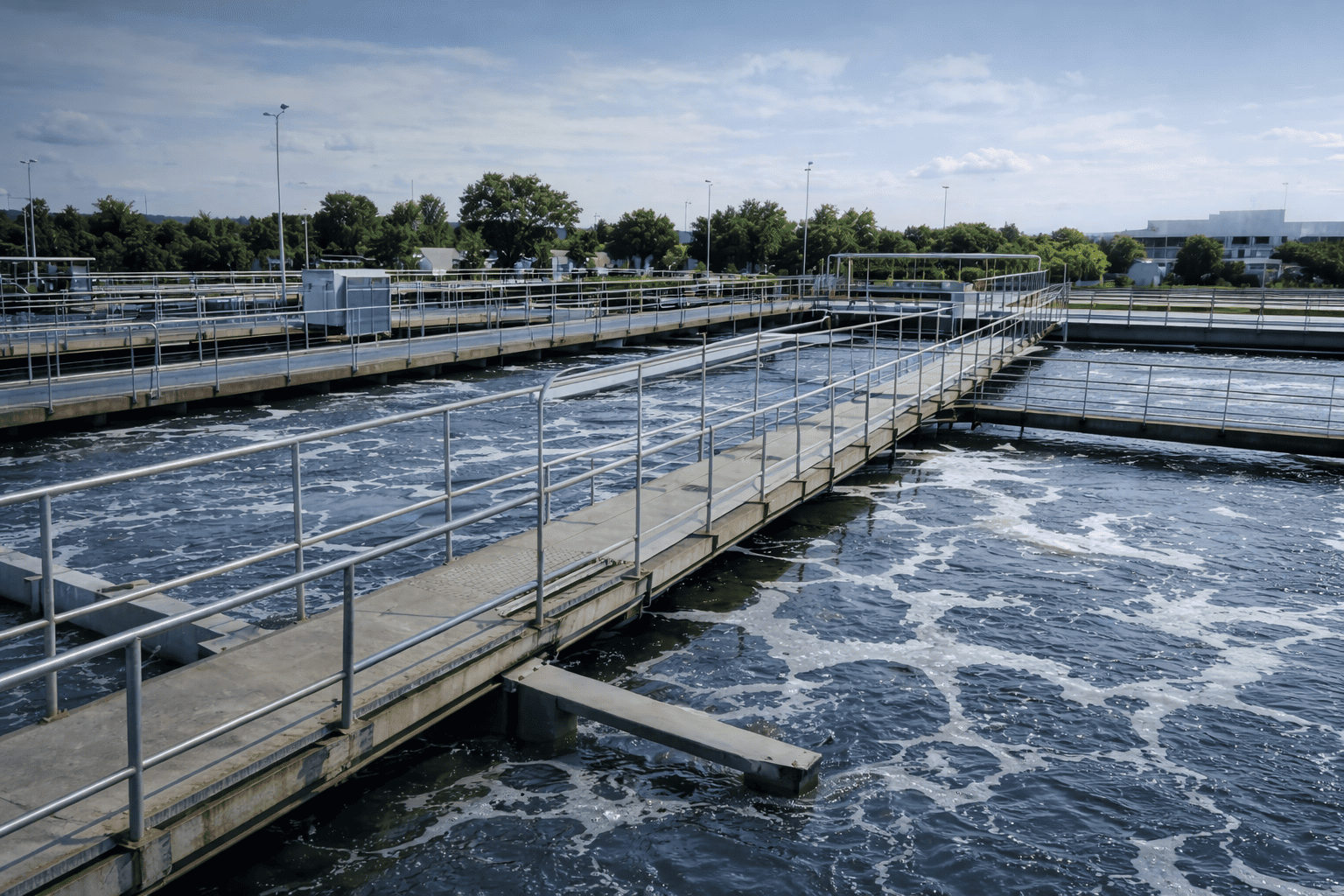
Your aeration tank is overflowing with brown foam. Or the clarifier has a grey mat of floating sludge. Or the outlet BOD is 120 mg/L on a system designed for 30 mg/L, and the MLSS is a perfectly normal 3,500 mg/L. These are Monday morning problems. The SPCB inspector is coming on Wednesday. You need a diagnosis, not a lecture on microbiology.
This guide is organized as a symptom-first troubleshooting protocol. Start with what you see, work backward to the cause, and get to the fix. Every section includes the first measurements to take and the corrective actions ranked by how quickly they work.
Filamentous Bulking: Causes and Fixes
Filamentous bulking is the most common biological problem in Indian industrial ETPs. The sludge settles poorly — SVI (Sludge Volume Index) climbs above 150 mL/g, sometimes above 300 mL/g — and dilute sludge escapes over the clarifier weir. The cause is always the same: filamentous organisms have outcompeted floc-forming bacteria for growth.
The specific filament matters because the fix depends on it. Check under a microscope (100x phase contrast) or send a sample to a lab. The dominant filament tells you the cause:
- Sphaerotilus natans: Low DO (<1.5 mg/L). Increase aeration. Check diffusers for fouling. Measure DO at multiple tank locations — dead zones cause local filamentous growth even when average DO looks fine.
- Thiothrix / type 021N: Sulfide in the feed. Check whether the equalization tank has gone septic. Aerate the equalization tank continuously. Increase RAS chlorination (3-5 mg/L free chlorine in return sludge) as a short-term fix.
- Microthrix parvicella: Low F:M, long SRT, high fat and oil content in the feed. Reduce sludge age by wasting more sludge. Improve FOG removal in DAF upstream.
- Type 1701 / Nostocoida limicola: Nutrient deficiency (N or P). Calculate BOD:N:P ratio. For domestic-type wastewater the target is 100:5:1. Industrial effluents often have far too little N relative to BOD. Dose urea or ammonium sulfate to correct.
Short-term control of any filamentous bulking: increase RAS chlorination to 3-5 mg/L free chlorine dosed into the RAS return line. This selectively kills filaments (which have more surface area exposed) without destroying the floc. Do not exceed 5 mg/L — above this, you start killing floc-forming bacteria too. Chlorinate for 2-4 hours per day until SVI drops below 150 mL/g.
Non-Filamentous (Zoogleal) Bulking
Non-filamentous bulking looks different: the sludge forms a thick, jelly-like mass that does not compact. The SVI is high but when you look under the microscope you see very few filaments. Instead, the flocs are embedded in excess extracellular polymer — a condition called zoogleal bulking or viscous bulking.
This usually occurs with high-carbohydrate wastewaters (sugar plants, brewery, food processing) at low F:M ratios. The bacteria produce excess polymer when substrate is limited and energy is available. The fix: increase F:M by reducing the MLSS (waste more sludge until MLSS drops to 2,000-2,500 mg/L) or increase the organic load by reducing aeration time.
If the MLSS is already low (<2,000 mg/L) and you still see viscous bulking, check the inlet for surfactants (detergents from CIP) — they stabilize the polymer matrix and make the condition worse. Improve DAF performance upstream or pre-treat with a coagulation step to remove surfactants.
Nocardia Foam: The Stubborn Brown Scum
Nocardia foam is unmistakable: thick, chocolate-brown, stable foam that builds up in the aeration tank and clings to walls. It does not collapse when sprayed with water the way ordinary biological foam does. You can scoop it up and it holds its shape. Under the microscope you see branching filamentous actinomycetes with waxy cell walls.
Nocardia grows very slowly (SRT >8 days required for significant growth) and is hydrophobic, which is why it concentrates in foam. It thrives when the feed contains long-chain fatty acids — exactly what you get from dairy, edible oil, meat processing, or any CIP effluent that contains surfactants and fats.
Immediate action: spray the foam with water to collapse it. Do not allow the foam to overflow back into the aeration tank — it will re-seed the system. Skim the foam off and waste it separately. Over the medium term, aggressively waste sludge to bring SRT below 8 days. This selectively eliminates Nocardia because it cannot reproduce fast enough. Expect 3-6 weeks for the foam to clear completely. Also investigate whether your DAF upstream is removing fats adequately — if it is not, the Nocardia problem will return.
Rising Sludge from Denitrification
Rising sludge in the secondary clarifier is often misdiagnosed as bulking. The difference: bulking sludge does not settle well from the beginning; rising sludge settles initially and then floats back up after 30-60 minutes in the clarifier. Do the Imhoff cone test — if the sludge settles in the first 30 minutes but you see gas bubbles forming and sludge rising after 45-60 minutes, it is denitrification rise, not bulking.
Rising sludge means your sludge blanket is sitting long enough in the clarifier for the anaerobic zone at the bottom to denitrify the nitrate carried in by the RAS. Nitrogen gas forms, bubbles attach to sludge flocs, and they float.
Fix: increase the RAS pumping rate. Target a sludge blanket depth of less than 0.5 m and sludge residence time in the clarifier of less than 1.5 hours. If your RAS pump is already at maximum, check whether the clarifier is hydraulically overloaded. If the plant is consistently running at >120% of design flow, the clarifier is undersized and you need a parallel unit.
Diagnosing High Outlet BOD
When outlet BOD is high, the first question is whether the problem is biological or hydraulic. These require completely different fixes. Run this decision tree:
Step 1: Measure TSS in the outlet. If TSS >50 mg/L, the problem is sludge carryover from the clarifier, not biological performance. Your biology is fine — the clarifier is losing sludge. Fix the clarifier (see rising sludge section above; check weir level, check for short-circuiting, check RAS rate).
Step 2: If TSS is normal (<30 mg/L) but BOD is high, measure BOD and COD on the same outlet sample. Calculate the BOD/COD ratio. If it is below 0.1, most of the remaining COD is non-biodegradable and the outlet BOD will naturally be low — the COD number is misleading you. If BOD/COD is above 0.2, biodegradable material is escaping treatment.
Step 3: Check the inlet COD log for the past 48 hours. A BOD spike in the outlet today usually reflects a COD shock load 12-24 hours ago — the biological system was overwhelmed and recovered, but not before some BOD passed through. If you see this pattern repeatedly, you need more equalization.
Step 4: Check your nutrient dosing. Low N or P causes the biological system to slow down. BOD removal efficiency drops from 95% to 70% or lower when nutrients are deficient. Measure NH₃-N and PO₄-P at the inlet to the biological reactor. Target: BOD:N:P ratio of 100:5:1.
MLSS Control: The Lever You Actually Have
Most activated sludge problems can be partially corrected by adjusting MLSS. MLSS is the one parameter you directly control through sludge wasting. Everything else — SVI, SRT, F:M ratio — is a consequence of MLSS and inlet load.
Target MLSS range for industrial activated sludge treating high-strength food wastewater: 3,000-5,000 mg/L. Below 2,000 mg/L and you have insufficient biomass to treat the load. Above 6,000 mg/L and oxygen transfer efficiency drops (the mixed liquor becomes too thick), clarifier performance deteriorates, and the system becomes fragile under shock loads.
Measure MLSS daily. The 30-minute settling test (30 minutes in a 1-litre graduated cylinder) and the calculation of SVI (settled volume in mL/g MLSS) takes 35 minutes and gives you more operational information than most automated monitoring. SVI below 100 mL/g is excellent settling. SVI 100-150 is acceptable. SVI above 200 means you have a settling problem and will see clarifier effluent TSS rising within 24-48 hours.
Sludge wasting: waste from the return sludge line (not from the aeration tank directly) for better control. Calculate waste sludge volume daily: Waste (m³/day) = (MLSS × reactor volume) ÷ (target SRT × RAS concentration × 1,000)
For a 370 m³ MBBR reactor at 3,500 mg/L MLSS, target SRT 10 days, RAS at 8,000 mg/L: Waste = (3,500 × 370) ÷ (10 × 8,000 × 1,000) ≈ 16 m³/day. This is the number your operator should be hitting every day, not guessing at.
ETP biology not performing?
Spans Envirotech provides on-site biological troubleshooting for activated sludge and MBBR systems across India. We diagnose the root cause and implement fixes — not just recommendations. Contact us for a site assessment.
Request a free proposal →