
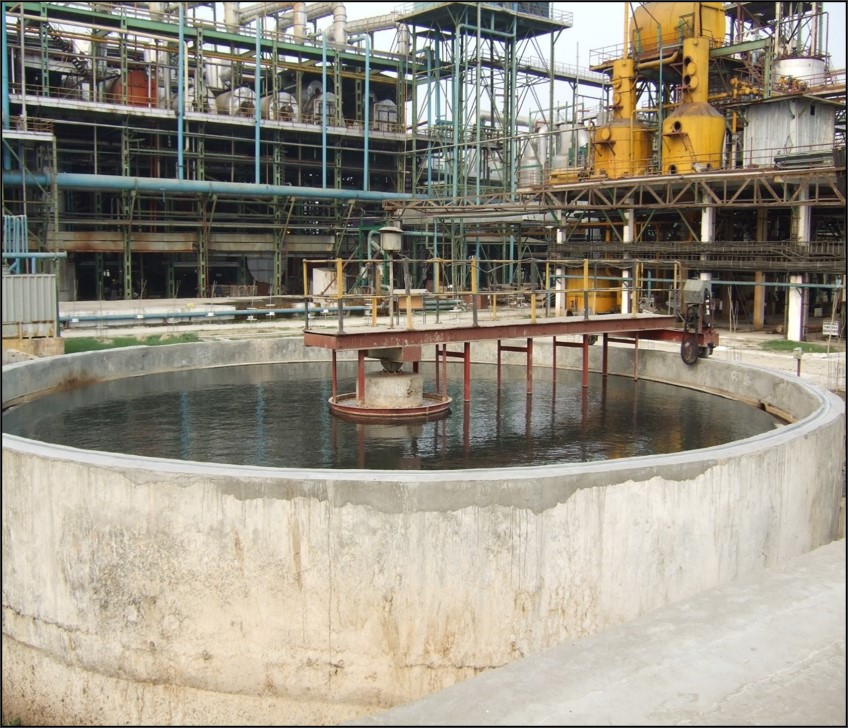
The aeration tank MLSS is 3,800 mg/L. The biology is working — BOD is being consumed, the activated sludge is active and healthy under the microscope. But the outlet BOD is 75 mg/L. TSS in the outlet is 120 mg/L. The problem is not the biology. It is the clarifier. The sludge is not settling properly and the suspended biological matter — which has high BOD — is escaping in the treated effluent.
This scenario plays out in Indian ETPs constantly. The secondary clarifier is the most consistently undersized element in ETP design because it looks like a simple settling tank — just a big round concrete structure. In practice it is a precision piece of equipment that requires careful hydraulic design. Get it wrong and the biological system cannot comply regardless of how well it is operated. This guide covers the key design parameters and the most common failure modes.
The Role of the Secondary Clarifier
The secondary clarifier serves two functions simultaneously: it clarifies the treated effluent (separates biological solids from the treated liquid) and it thickens the return sludge (concentrates the settled sludge to a pumpable concentration for return to the aeration tank). Both functions must work for the system to perform.
The secondary clarifier is not just a tank where sludge settles. The sludge blanket that forms in the bottom of the clarifier is a dynamic, living mass — still consuming substrate, denitrifying nitrate, and undergoing biological transformations. If the sludge blanket becomes too deep or sits too long in the clarifier, it goes anaerobic, generates gas, and the sludge floats.
This is why clarifier design is not just hydraulics — it is also biology. The sludge must spend long enough in the clarifier to thicken and settle (typically 1.5-3 hours), but not so long that it goes anaerobic (more than 3-4 hours for most industrial sludges at Indian temperatures).
Solids Loading Rate: The Critical Parameter
SLR (Solids Loading Rate) is the single most important design parameter for secondary clarifiers. It is the total solids flux (kg TSS per day) divided by the clarifier surface area (m²), expressed in kg/m²/hr.
SLR = MLSS (kg/m³) × (Q + Qr) (m³/hr) ÷ A (m²)
Where Q is average influent flow and Qr is return sludge flow. Note that the total flow entering the clarifier is Q + Qr — not just Q. Many undersized clarifiers have been built by calculating SLR on Q alone, which underestimates actual solids loading by 40-100%.
Design SLR limits for industrial wastewater:
- Well-settling sludge (SVI <100 mL/g): Maximum 7-8 kg/m²/hr at average flow; 12 kg/m²/hr at peak
- Normal sludge (SVI 100-150 mL/g): Maximum 5-6 kg/m²/hr at average flow; 9-10 kg/m²/hr at peak
- Poorly settling sludge (SVI 150-250 mL/g): Maximum 3-4 kg/m²/hr at average flow; 6-7 kg/m²/hr at peak
- Bulking sludge (SVI >250 mL/g): Clarifier cannot function — resolve bulking first
Check your existing clarifier SLR using current operational data. If you are above the design SLR limit for your observed SVI, clarifier failure is not occasional — it is inherent in the design. You need either a larger clarifier, reduced MLSS (lower sludge inventory), or improved sludge settling (reduced SVI).
Surface Overflow Rate
SOR (Surface Overflow Rate) is the upward liquid velocity in the clarifier, equal to the feed flow divided by the clarifier surface area. It determines whether particles can settle against the upward liquid movement.
SOR = Q (m³/day) ÷ A (m²) = m³/m²/day = m/day
A particle settles only if its settling velocity exceeds the upward SOR velocity. Biological sludge flocs settle at 1-5 m/hour (24-120 m/day) for well-settling sludge; 0.2-0.8 m/hour (5-20 m/day) for bulking or poorly settling sludge. This is why the design SOR range (20-30 m/day) provides adequate margin for normal sludge but leaves almost no margin for poorly settling sludge.
For a 500 KLD plant with average flow 21 m³/hr (500 ÷ 24):
- At SOR of 25 m³/m²/day: required area = 500 ÷ 25 = 20 m² (5 m diameter circular clarifier)
- At SOR of 20 m³/m²/day: required area = 500 ÷ 20 = 25 m² (5.6 m diameter)
- At peak flow factor 2.5 × 500 = 1,250 KLD: SOR at peak = 1,250 ÷ 25 = 50 m/day — acceptable at peak only
Sludge Blanket Depth Monitoring
The sludge blanket depth in the secondary clarifier must be monitored daily in any well-operated ETP. It is the single most useful real-time indicator of clarifier health.
Measurement method: use a sludge blanket probe (a weighted transparency tube with a float that stops at the sludge-water interface) lowered from a designated measurement point on the clarifier bridge. Measure from the water surface to the top of the sludge blanket. Standard frequency: once per shift, or continuously with an ultrasonic sludge blanket detector.
Target sludge blanket depth: maximum 0.5-0.8 m from the clarifier floor for most Indian industrial ETPs. The sludge blanket should not exceed 1.5 m depth — beyond this, the lower anaerobic zone grows large enough to cause denitrification rise, floating sludge, and effluent TSS spikes.
When sludge blanket depth exceeds target: increase RAS pumping rate (pump more sludge back to the aeration tank) and/or increase waste sludge pumping (reduce MLSS inventory). If RAS is already at maximum capacity and sludge blanket is rising, the clarifier is hydraulically overloaded relative to the sludge settling rate.
Return Activated Sludge Ratio and Control
The RAS ratio (return sludge flow ÷ influent flow) is the primary control variable available to the operator. Increasing RAS decreases sludge blanket depth by returning sludge to the aeration tank faster. Decreasing RAS allows sludge to thicken more in the clarifier (higher RAS concentration, lower RAS flow volume).
Typical RAS concentration: if MLSS is 3,500 mg/L and RAS ratio is 0.5, the RAS concentration is approximately MLSS × (1 + RAS ratio) / RAS ratio = 3,500 × 1.5 / 0.5 = 10,500 mg/L. This is the concentration at which the return sludge is being pumped back. Verify this by sampling the RAS line and measuring TSS.
For plants with variable flow (batch processes), increase RAS during peak flow periods (higher hydraulic loading pushes sludge blanket up) and reduce RAS during low-flow periods (sludge can thicken more, reducing RAS pump energy). Variable frequency drives on RAS pumps allow this control. A fixed-speed RAS pump running at constant flow is a design limitation that contributes to clarifier instability during flow variation.
Imhoff Cone Settling Test Interpretation
The Imhoff cone test is a simple but powerful daily operational test. Fill a 1-litre Imhoff cone with mixed liquor from the aeration tank (or with clarifier effluent for TSS estimation). Record the settled volume after 30 minutes.
Calculate SVI: SVI (mL/g) = settled volume (mL/L) × 1,000 ÷ MLSS (mg/L)
SVI interpretation:
- SVI <100 mL/g: Excellent settling. Clarifier will perform well at standard SLR and SOR design limits.
- SVI 100-150 mL/g: Good settling. Normal operating range for activated sludge.
- SVI 150-200 mL/g: Marginally poor settling. Monitor closely, check for filaments, consider increasing RAS.
- SVI 200-300 mL/g: Poor settling (bulking). Clarifier performance is compromised. Investigate and correct the biological cause.
- SVI >300 mL/g: Severe bulking. Sludge is not settling usefully. Clarifier will overflow. Emergency intervention required.
Also do the Imhoff cone test on clarifier effluent (not mixed liquor): settled volume in clarifier effluent after 30 minutes should be near zero. Any visible settled solids in clarifier effluent at 30 minutes means TSS in the treated effluent is above 30-50 mg/L — a compliance risk.
Common Failure Modes
Secondary clarifier failures in Indian ETPs cluster around four modes:
1. Rising sludge (denitrification): Grey sludge clumps floating at the surface, with gas bubbles visible. Sludge settles initially in Imhoff cone but floats after 45-60 minutes. Fix: increase RAS to reduce sludge blanket residence time. Reduce nitrification if excessive denitrification is occurring in the clarifier.
2. Filamentous overflow: Thin, stringy sludge escaping over weir, effluent looks cloudy or greenish-grey. Imhoff cone shows poor 30-minute settling (SVI >200). Fix: treat the filamentous bulking in the aeration system (see activated sludge troubleshooting guide).
3. Hydraulic overload during peak flow: Clarifier performs well during normal flow but fails during peak production periods. Effluent TSS spikes 2-4x during peak flow. Fix: operational — increase RAS during peak flow. Long-term fix — add a second clarifier or increase clarifier area.
4. Weir and scum issues: Uneven weir level (one section lower than others) causes flow to short-circuit to the lower weir section, drawing sludge that is not fully settled. Check weir level with a spirit level and adjust. Also check whether the surface scum baffle (submerged baffle inside the weir) is present and undamaged — its absence allows floating material (foam, scum) to escape over the weir.
Lamella Clarifiers as Alternatives
Lamella (inclined plate settler) clarifiers achieve the same separation in 3-5x less footprint than conventional circular clarifiers by using stacked inclined plates to create effective settling area equivalent to a much larger tank.
For secondary clarification, lamella clarifiers are appropriate when: site footprint is constrained; flow is below 200 KLD; or the system is a polishing step downstream of an MBBR or SBR with already-low TSS. They are not appropriate for high-MLSS activated sludge applications (>4,000 mg/L) because sludge blanket control is harder and sludge can bridge between the lamella plates.
Lamella clarifier design SOR is based on projected horizontal settling area (sum of plate areas), not the plan area of the tank. At 5-10 m³/m²/day on projected area, a 5 m² footprint lamella unit can achieve the same separation as a 25-40 m² conventional clarifier. For sites where adding a 5 m diameter concrete clarifier is impossible, a lamella unit occupying 5-8 m² is often the viable upgrade path.
Is your clarifier the bottleneck?
Spans Envirotech designs secondary clarifiers, lamella settlers, and clarifier upgrades for activated sludge and MBBR systems across India. If your biological system is working but your effluent TSS is above compliance limits, we can help diagnose and fix the clarifier. Contact us for a site assessment.
Request a free proposal →