
Effluent Treatment Plant (ETP)
Complete multi-stage industrial wastewater treatment systems — treating effluent from primary through tertiary stages to meet regulatory discharge standards or recover water for process reuse
Overview
About Effluent Treatment Plant (ETP)
An Effluent Treatment Plant (ETP) is a complete wastewater treatment system designed to process industrial effluent — removing pollutants including suspended solids, organic matter (measured as BOD and COD), oils, heavy metals, nutrients, and colour — to a quality suitable for safe environmental discharge as per regulatory limits, or to a quality suitable for recycling back into the industrial process. ETPs are site-specific engineered systems, with the treatment train designed around the characteristics of the specific industrial effluent.
A well-designed ETP integrates multiple treatment stages in sequence. Primary treatment removes large solids, oils, and greases through physical processes: screening, grit removal, oil-water separation (API separators, CPI/TPI separators), and primary clarification (conventional or lamella clarifiers, or dissolved air flotation). Secondary treatment employs biological processes — aerobic (MBBR, MBR, activated sludge), anaerobic (UASB, fixed-film reactors), or combined — to degrade dissolved organic pollutants. Tertiary treatment polishes the secondary-treated effluent through filtration (sand filters, disc filters, activated carbon filters), membrane treatment (UF, RO), or chemical disinfection to achieve final discharge or reuse quality.
Anaerobic pre-treatment is a particularly valuable component of ETPs serving high-COD industries such as distilleries, breweries, dairy, food processing, and pulp & paper. Anaerobic systems generate biogas (primarily methane) as a byproduct of organic matter degradation, which can be used to offset fuel costs or generate electricity — providing a direct economic return on treatment investment. Integration of anaerobic pre-treatment with aerobic secondary treatment dramatically reduces the energy demand of the overall ETP compared to aerobic-only systems.
Sludge management is an integral part of ETP design. Biological and chemical sludge generated during treatment must be thickened (using DAF thickeners or gravity thickeners), dewatered (using belt filter presses, screw presses, or volute dewatering units), and either disposed of or beneficially reused — as fertiliser, soil conditioner, or biogas feedstock through anaerobic digestion.
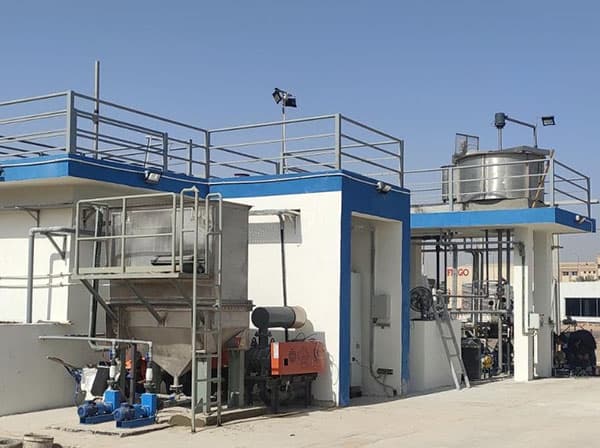
Packaged ETPs are factory-assembled, skid-mounted or containerized effluent treatment plants that incorporate all essential treatment stages in a pre-engineered compact module. Based on MBR, SBR, or MBBR technology and available in capacities from 25 KLD to 250 KLD, packaged ETPs are ideal for small to medium industrial facilities that need a turnkey, rapidly deployable treatment solution with minimal civil construction. They are fully automated and designed for unmanned or minimum-operator scenarios.
Process
ETP Treatment Stages
Preliminary & Primary Treatment
Incoming effluent passes through bar screens and grit chambers to remove large solids. Oil-water separation (API separator, CPI/TPI unit) removes free oils and greases. Primary clarification (conventional clarifier or DAF) removes suspended solids and primary sludge before the effluent proceeds to biological treatment.
Anaerobic Pre-treatment (High-COD Effluents)
For high-strength effluents (COD >2,000 mg/L), an anaerobic reactor (UASB, fixed-film, or SMAR) degrades a large fraction of the soluble organic load without oxygen input. The process produces biogas rich in methane, which is captured and used for energy. Anaerobic pre-treatment dramatically reduces the load on the downstream aerobic biological stage, cutting overall energy consumption.
Aerobic Biological Treatment
Secondary aerobic treatment — using technologies such as MBBR, MBR, conventional activated sludge, or SBR — degrades remaining dissolved organics and reduces BOD and COD to near-discharge levels. Nutrients (nitrogen, phosphorus) can be removed simultaneously in combined anoxic-aerobic systems.
Secondary Clarification
Biological sludge is separated from treated water in a secondary clarifier (conventional clarifier or lamella clarifier). Clarified effluent overflows to tertiary treatment; return activated sludge is recycled to the biological reactor, and waste sludge is directed to sludge handling.
Tertiary Treatment & Polishing
Tertiary polishing using sand filters, activated carbon filters, disc filters, or membrane systems (UF, RO) removes residual suspended solids, colour, micropollutants, and dissolved salts to achieve discharge compliance or the quality standard required for process water reuse.
Sludge Treatment & Disposal
Sludge from primary, secondary, and chemical treatment stages is thickened and dewatered using mechanical dewatering equipment (belt filter press, screw press, volute dewatering). Dewatered cake is disposed of or beneficially reused. Sludge drying can further reduce volume for cost-effective disposal.
Benefits
Key Advantages
- Complete turnkey system covering all treatment stages from screening to final discharge or reuse
- Treats effluent to regulatory discharge standards or process reuse quality as required
- Biogas recovery from anaerobic stages offsets energy costs and provides economic return on treatment
- Modular design enables phased expansion as production capacity grows
- Integrated sludge management reduces disposal volumes and costs
- Water reuse reduces freshwater consumption — significant cost saving and environmental benefit
- Addresses all pollutant categories: solids, organics, oils, nutrients, heavy metals, and colour
- Custom-designed for each industrial sector's specific effluent characteristics and regulatory requirements
- Energy-efficient process sequencing: anaerobic pre-treatment minimises aerobic energy demand
- Long operational life with proven technologies and robust equipment selection
Applications
Industries & Use Cases
Get a Quote or Technical Consultation
Our engineers can help you select the right effluent treatment plant (etp) configuration for your application.
Free ETP Design Tools
Use our calculators to size your ETP system and estimate operating parameters.