
Ultra Filtration (UF)
Semi-permeable membrane filtration removing bacteria, viruses, suspended solids, colour, and turbidity from water and wastewater — essential pre-treatment for reverse osmosis and tertiary polishing for industrial and municipal reuse
Overview
About Ultra Filtration (UF)
Ultra Filtration (UF) is a pressure-driven membrane separation process that removes suspended and colloidal matter from water by passing it through a semi-permeable membrane with pore sizes in the range of 0.01 to 0.1 microns. This pore size range places UF between microfiltration (larger pores, removes larger particles) and nanofiltration/reverse osmosis (smaller pores, removes dissolved ions). UF membranes effectively remove all suspended solids, bacteria, protozoa, viruses, colloids, colour-causing macromolecules, and high-molecular-weight dissolved organics, while passing water, salts, and small dissolved molecules through to the permeate.
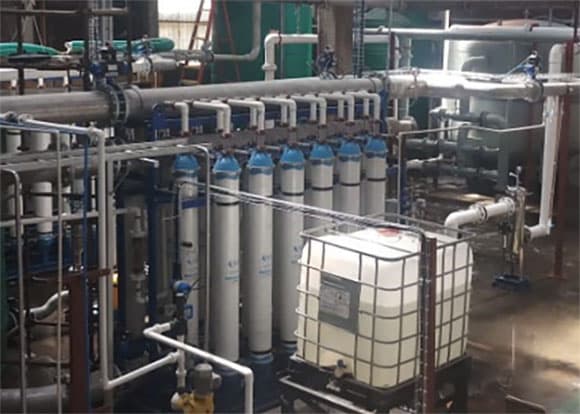
UF systems are available in hollow-fibre membrane modules (inside-out or outside-in flow configuration) and, less commonly, spiral-wound configurations. Hollow-fibre modules are the dominant technology for water treatment applications, providing very high membrane surface area per unit volume and the ability to be backwashed and chemically cleaned in-place (CIP) to restore flux. Modules are housed in pressure vessels and connected in arrays to achieve the required permeate flow rate.
In water and wastewater treatment, UF most commonly serves two distinct roles: as a final tertiary polishing stage to produce high-quality reuse water meeting turbidity (<0.1 NTU), bacteria, and virus removal targets; and as a pre-treatment stage ahead of reverse osmosis (RO) membranes to protect the RO from fouling by suspended solids, colloids, and biological matter that would otherwise rapidly degrade RO performance. In pulp and paper applications, UF plays an important role in treating paper machine effluent for fibre and chemical recovery.
Process
How Ultra Filtration Works
Feed Water Pre-screening
Feed water to the UF system typically passes through a coarse pre-filter or strainer (50–200 microns) to remove large particles that could physically block the membrane module inlet ports. Pre-chlorination may be applied to control biological growth on the membrane, followed by dechlorination where chlorine would damage the membrane material.
Pressurised Flow Through Membrane
Feed water is pressurised (typically 0.5–2.0 bar) and forced through the UF membrane. For hollow-fibre modules, water flows either from the inside of the fibres outward (inside-out) or from outside the fibres through the fibre walls (outside-in). Water molecules and small dissolved compounds pass through the membrane pores; particles, colloids, bacteria, viruses, and large molecules are retained on the feed side.
Permeate Collection
The water that passes through the membrane — the permeate — is collected and sent to the next treatment stage (RO system, disinfection, or storage for reuse). Permeate turbidity is typically <0.1 NTU, free of all bacteria and viruses (>4 log removal of bacteria, >3 log removal of viruses).
Concentrate / Reject Handling
A small fraction of the feed flow carries the retained suspended solids, biological matter, and concentrated contaminants to the reject (concentrate) outlet. The reject is returned to the upstream treatment system or directed to sludge handling for disposal. UF recovery rates are typically 90–95%.
Backwash Cleaning
Periodically (typically every 20–60 minutes), the UF system undergoes automatic backwashing in which permeate is pumped backward through the membrane at elevated pressure to dislodge accumulated foulants from the membrane surface. Air scouring may be applied simultaneously to enhance cleaning. Backwash cycles last 30–60 seconds.
Chemical In-Place Cleaning (CIP)
Over longer operating periods, irreversible fouling reduces membrane permeability. CIP is performed periodically (weekly to monthly) by recirculating cleaning solutions (caustic for organic fouling, acid for mineral scaling, sodium hypochlorite for biofouling) through the membrane modules at controlled temperature to restore flux.
Benefits
Key Advantages
- Absolute barrier to bacteria, protozoa, and viruses — independent of influent variability
- Consistently produces permeate with turbidity <0.1 NTU — suitable for high-quality reuse
- Removes suspended solids, colloids, colour, and high-molecular-weight organics in a single pass
- Reliable pre-treatment for RO membranes — reduces RO fouling and cleaning frequency significantly
- High recovery rate (90–95%) minimises water wastage
- Automated backwash and CIP maintain stable performance with minimal operator attention
- Compact modular design — easy to expand capacity by adding membrane modules or racks
- Consistent performance regardless of seasonal influent quality variations
- No chemical addition required during normal filtration (unlike coagulation-based processes)
- Long membrane service life (5–10+ years) with proper operation and cleaning
Applications
Industries & Use Cases
Get a Quote or Technical Consultation
Our engineers can help you select the right ultra filtration (uf) configuration for your application.