
Motorized & Manual Sluice Gates
Heavy-duty slide gates for reliable flow isolation, diversion, and regulation in municipal and industrial wastewater treatment plants, irrigation channels, pump stations, and reservoirs
Overview
About Motorized & Manual Sluice Gates
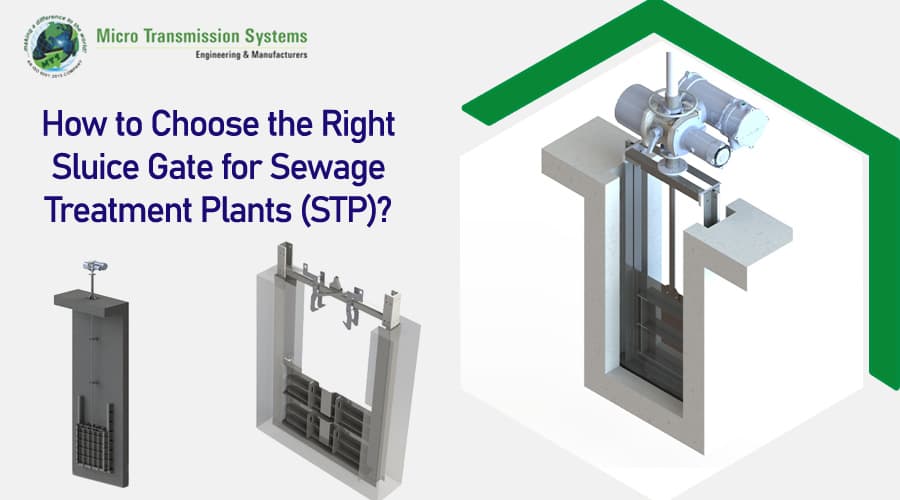
A sluice gate (also called a penstock or slide gate) is a flat-panel gate that slides vertically within a frame to open, close, or throttle flow through an opening in a wall, channel, or pipe. It is one of the most fundamental flow-control devices in water and wastewater infrastructure, used wherever a positive shut-off or controlled flow diversion is required — from the inlet screens of a sewage treatment plant to the inter-stage chambers of an effluent treatment plant and the sluiceways of irrigation canals.
Sluice gates are available in two operational modes: manual and motorized. Manual gates are operated by a handwheel or bevel gear mechanism that raises or lowers the gate via a spindle, suitable for infrequently operated isolation points or locations without power supply. Motorized gates use an electric actuator (quarter-turn or linear) coupled to the spindle, enabling remote or automated operation from a SCADA/PLC system — essential for process sequences, flood control, and unmanned installations.
Construction materials are selected based on corrosion exposure and sealing requirements. Carbon steel gates with epoxy coating are standard for freshwater and mild wastewater service. Stainless steel (SS304 or SS316) gates are specified for aggressive industrial effluents, seawater intake, and hygienic applications. Frame and gate geometries are customised to match the wall opening, and sealing arrangements (rubber seals on three or four sides) are designed to achieve near-zero leakage across the closed gate.
Gate sizes typically range from 300 mm × 300 mm to 3000 mm × 3000 mm, with larger custom sizes available for dam sluiceways and flood control structures. Seating head (upstream water pressure) and unseating head (gate operated against flow) ratings determine the frame stiffness and actuator torque requirements.
Process
How Sluice Gates Work
Frame Installation
The gate frame is cast or bolted into the concrete wall or channel structure, forming a smooth seating surface against which the gate panel makes contact. The frame is sized to match the opening dimensions and rated for the maximum hydrostatic head.
Gate Panel Travel
The gate panel slides vertically within the frame guides. Upward travel opens the aperture progressively, allowing flow to pass underneath the rising gate leaf. Full opening raises the panel clear of the flow cross-section; full closure brings the gate panel into contact with the seating faces on all sides.
Sealing Mechanism
Rubber seals fitted to the gate panel periphery compress against the machined frame seating faces when the gate is closed, achieving near-zero leakage. Seal designs include flat face, wedge, and bulb profiles depending on the required seating load and leakage class.
Manual Operation
For manually operated gates, a handwheel or bevel gear at the top of the spindle is turned by the operator. Mechanical advantage from the gear ratio reduces the effort required to lift the gate against water pressure. A position indicator shows the gate opening percentage.
Motorized/Actuated Operation
For motorized gates, an electric linear actuator replaces the handwheel, driving the spindle up or down via limit switches that stop travel at fully open and fully closed positions. The actuator receives control signals from a local panel, SCADA system, or automated PLC sequence, enabling remote operation and monitoring.
Flow Control & Throttling
Partially opened sluice gates can throttle flow by restricting the aperture area. However, for precise flow regulation, a throttling gate (with a guided panel designed for partial-open conditions) is preferred over a standard isolation gate to prevent vibration and seal damage from sustained partial opening.
Benefits
Key Advantages
- Positive shut-off capability for complete flow isolation between treatment stages or chambers
- Motorized versions enable automated, remote, and SCADA-integrated operation without manual intervention
- Wide size range from 300 mm to 3000 mm covers inlet channels, inter-tank connections, and bypass lines
- Choice of carbon steel, SS304, and SS316 construction suits freshwater, industrial effluent, and seawater service
- Robust mechanical design tolerates debris, grit, and floating solids without jamming
- Low maintenance requirements — periodic lubrication of spindle and seal inspection
- Fail-safe options (fail-open or fail-closed actuators) available for safety-critical applications
- Epoxy or polyurethane coatings resist corrosion in humid, chemically active environments
- Custom frame and gate dimensions to fit existing civil openings without structural modification
- Compliant with IS, BS, and ISO standards for water control gates
Applications
Industries & Use Cases
Get a Quote or Technical Consultation
Our engineers can help you select the right motorized & manual sluice gates configuration for your application.