
Sewage Treatment Plant (STP)
Complete municipal and domestic wastewater treatment systems — from screening through biological treatment, clarification, sludge dewatering, and tertiary disc filtration to meet discharge standards or produce treated water for reuse; including packaged containerized STPs for rapid deployment
Overview
About Sewage Treatment Plant (STP)
A Sewage Treatment Plant (STP) is a wastewater treatment system designed to process domestic sewage and municipal wastewater — separating pollutants including settleable solids, organic matter (BOD, COD), pathogens, suspended solids, and nutrients — to produce treated effluent suitable for safe environmental discharge or reuse in applications such as irrigation, toilet flushing, cooling tower makeup, and landscaping. STPs serve municipalities, residential townships, commercial complexes, hospitals, institutions, and industrial facilities that generate domestic wastewater.
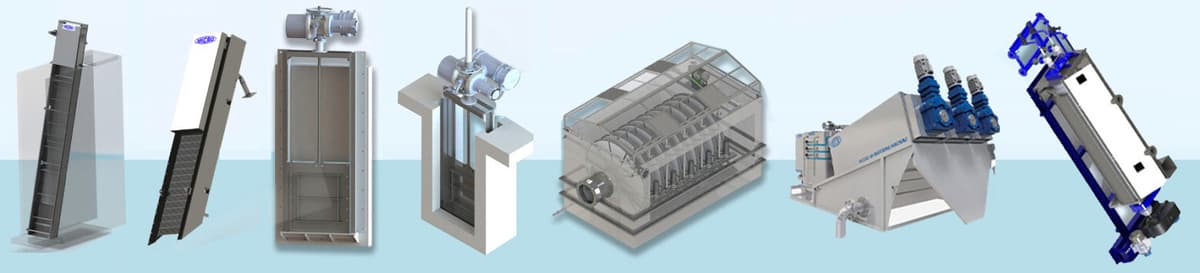
The treatment sequence in a modern STP begins with preliminary treatment — coarse and fine screening removes rags, plastic, and grit. Primary clarification (conventional clarifiers or DAF units operating as sludge thickeners) removes settleable solids ahead of the biological stage. Biological secondary treatment using aerobic processes (MBBR, MBR, SBR, or activated sludge) degrades dissolved organic matter and reduces BOD to levels required for discharge. Secondary clarification using lamella or conventional clarifiers separates biological sludge from the treated water.
Tertiary treatment has become increasingly important in India and globally, driven by requirements for treated sewage to meet higher reuse quality standards. Disc filters — mandatory in many Indian state regulations post-secondary clarification in STPs — provide a final polishing stage that removes residual suspended solids to below 5 mg/L, enabling the treated water to meet standards for flushing, irrigation, or other non-potable reuse applications. UV disinfection or chlorination is applied after filtration to achieve microbial quality requirements.
Sludge generated during primary and secondary treatment must be concentrated and dewatered before disposal. DAF units serve as sludge thickeners in STPs, concentrating dilute biological sludge before it is dewatered using mechanical presses (belt filter press, screw press). Dewatered sludge cake may be composted for agricultural use or disposed of to landfill.
Packaged STPs are factory-assembled, skid-mounted or containerized treatment units that integrate all treatment stages — screening, biological reactor, clarifier, and sludge handling — in a pre-engineered compact assembly. Available in capacities from 25 KLD to 250 KLD based on MBR, SBR, or MBBR technology, packaged STPs can be rapidly deployed, transported, and commissioned with minimal civil construction. They are ideal for residential townships, hotels, IT campuses, defence establishments, and temporary or emergency water reuse requirements where a permanent large-scale civil STP is not feasible or not yet ready.
Process
STP Treatment Stages
Preliminary Treatment (Screening & Grit Removal)
Incoming sewage passes through coarse bar screens and fine bar screens to remove solid objects, rags, plastics, and large debris. A grit chamber or grit cyclone removes inorganic grit (sand, gravel) that would otherwise cause abrasion damage to downstream pumps and equipment.
Primary Clarification
Primary treatment in a conventional clarifier or primary settling tank removes settleable organic solids from the screened sewage, reducing the BOD and TSS load to the biological stage. Separated primary sludge is pumped to the sludge handling system.
Biological Secondary Treatment
The pre-settled sewage undergoes aerobic biological treatment in a process such as MBBR, MBR, activated sludge, or SBR. Microorganisms degrade dissolved organic matter (BOD), ammonia (nitrification), and in combined anoxic-aerobic systems, nitrate (denitrification). Aeration provides dissolved oxygen for biological respiration.
Secondary Clarification
Biological sludge is separated from the treated effluent in a secondary clarifier (lamella or conventional). Return activated sludge (RAS) is recirculated to the bioreactor to maintain the required biomass concentration; waste activated sludge (WAS) is directed to sludge thickening.
Tertiary Filtration & Disinfection
Secondary clarifier overflow undergoes tertiary polishing through disc filters or sand filters to remove residual suspended solids to <5 mg/L. UV disinfection or chlorination inactivates pathogens (bacteria, viruses) to meet microbial discharge or reuse standards.
Sludge Thickening & Dewatering
Dilute biological sludge from secondary clarification is thickened using a DAF sludge thickener or gravity belt thickener. Thickened sludge is then mechanically dewatered using a belt filter press or screw press to produce a cake (15–30% dry solids) for disposal or beneficial reuse.
Benefits
Key Advantages
- Achieves treated effluent quality for safe environmental discharge per CPCB/SPCB discharge standards
- Produces reuse-quality treated water suitable for irrigation, toilet flushing, and industrial cooling
- Tertiary disc filtration achieves <5 mg/L TSS — required for treated sewage reuse in India
- Integrated sludge treatment reduces sludge disposal volumes and costs
- Modular plant designs scalable from small residential STPs to large municipal plants
- Compact footprint designs suitable for space-constrained urban sites
- Low odour operation with covered primary treatment and enclosed sludge handling
- Long operational life with proven biological and mechanical technologies
- Compatible with decentralised STP networks for large residential and commercial developments
- Comprehensive design covering all regulatory requirements for installation and operation
Applications
Industries & Use Cases
Get a Quote or Technical Consultation
Our engineers can help you select the right sewage treatment plant (stp) configuration for your application.
Free STP Sizing Tools
Estimate your STP capacity requirements and hydraulic parameters with our free calculators.