
Pressure Sand Filter
Granular media pressure filtration to remove suspended solids, silt, clay, and organic matter from water and wastewater — sand, dual-media, and multi-grade configurations achieving <20 mg/L TSS output
Overview
About Pressure Sand Filter
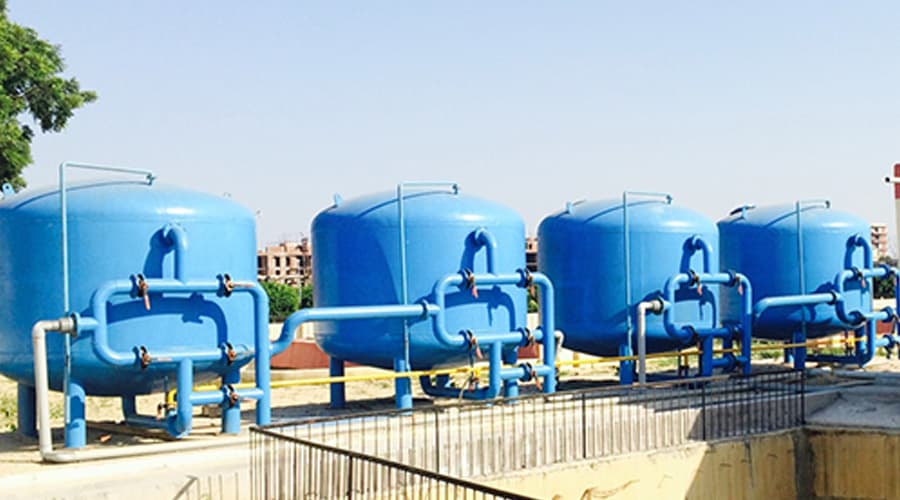
Pressure sand filters are closed, pressurised vessels containing a bed of granular filter media through which water or wastewater is forced under pressure to remove suspended solids, turbidity, silt, clay, fine organic matter, and microorganisms. They represent one of the most widely used tertiary treatment and water polishing technologies, deployed across drinking water treatment, industrial process water production, and wastewater reclamation applications.
Three primary media configurations are available based on the required filtration duty and influent quality. A single sand filter uses graded silica sand to remove particles by straining, depth filtration, and surface adsorption. A dual-media filter (DMF) uses anthracite coal above a sand layer — the coarser anthracite captures larger particles in the upper zone, extending the run length before breakthrough while the sand provides fine filtration. A multi-grade filter (MGF) uses three or more layers of media of progressively finer gradation, providing even longer run lengths and finer filtration in high-turbidity or high-TSS applications.
Under normal operating conditions, filtered water exits the vessel with a total suspended solids (TSS) concentration of less than 20 mg/L. When accumulated solids create a differential pressure rise to the set backwash trigger point, the filter is taken offline briefly and backwashed with upward-flowing clean water to fluidise and clean the media bed. After settling, the filter returns to service. Pressure sand filters can be installed indoors or outdoors, vertically or horizontally, and are used standalone or in series with activated carbon filters and membrane systems.
Process
How a Pressure Sand Filter Works
Influent Entry & Distribution
Water or wastewater enters the pressure vessel at the top through an inlet distributor that spreads flow evenly across the full media surface. Uniform distribution prevents channelling and ensures the full bed depth is used for filtration.
Downflow Through Granular Media
Water flows downward through the graded granular media bed under the applied inlet pressure. Suspended solids are captured within the media by three mechanisms: physical straining (particles too large to pass between grains), depth filtration (particles adhere to grain surfaces within the bed), and flocculation (particles collide and clump within the pore spaces).
Filtrate Collection
Filtered water collects below the support gravel layer and exits through the underdrains at the bottom of the vessel. Outlet water typically contains <20 mg/L TSS, making it suitable for reuse, discharge compliance, or further polishing by activated carbon filters or membrane systems.
Differential Pressure Monitoring
Pressure gauges or transmitters continuously monitor the differential pressure across the media bed. As accumulated solids fill the pore spaces, the differential pressure increases. When it reaches the preset backwash trigger point (typically 0.5–1.0 bar), the filter automatically initiates backwash.
Backwash Cleaning
The filter inlet is closed and clean backwash water is pumped upward through the media bed at a rate sufficient to fluidise and expand the bed by 20–30%. Turbulence between the media grains dislodges and carries accumulated solids out of the vessel via the backwash outlet for disposal or recycling to the treatment system.
Media Settling & Return to Service
Backwash flow is stopped, the media bed settles and stratifies with finer media above coarser (for single sand) or anthracite above sand (dual-media). After a brief rinse cycle, the filter returns to normal downflow service with restored filtration capacity.
Benefits
Key Advantages
- Produces filtered water with <20 mg/L TSS — suitable for reuse, discharge, or further polishing
- Three media configurations: sand, dual-media (DMF), and multi-grade filter (MGF) for varying influent quality
- Simple, proven technology with decades of reliable performance in water and wastewater treatment
- Automatic backwash system maintains performance without continuous operator attention
- Protects downstream activated carbon filters and membrane systems (UF, RO) from high solids loading
- Vertical and horizontal pressure vessel orientations to suit site layout constraints
- Indoor and outdoor installation capability
- Handles high flow rates — systems can be configured with multiple vessels in parallel
- Low operating energy — gravity-driven pressure through the bed with minimal pump head loss
- ASME and IS pressure vessel design standards for safety and longevity
Applications
Industries & Use Cases
Explore More
Related Products
Get a Quote or Technical Consultation
Our engineers can help you select the right pressure sand filter configuration for your application.