
Grit Removal Systems
Detritors and vortex grit separators for the removal of sand, grit, gravel, and abrasive inorganic particles from municipal sewage and industrial effluent — protecting downstream pumps, pipelines, aeration diffusers, and biological treatment equipment
Overview
About Grit Removal Systems
Grit removal is an essential preliminary treatment step in every municipal sewage treatment plant and in industrial wastewater plants receiving inorganic-laden streams. Grit consists of sand, gravel, cinders, eggshells, bone fragments, and other dense inorganic particles that are transported with the wastewater flow. If not removed early in the treatment sequence, grit causes rapid wear and damage to pumps, pipelines, valves, and aeration diffusers, and accumulates in biological reactors and clarifiers, progressively reducing their effective volume.
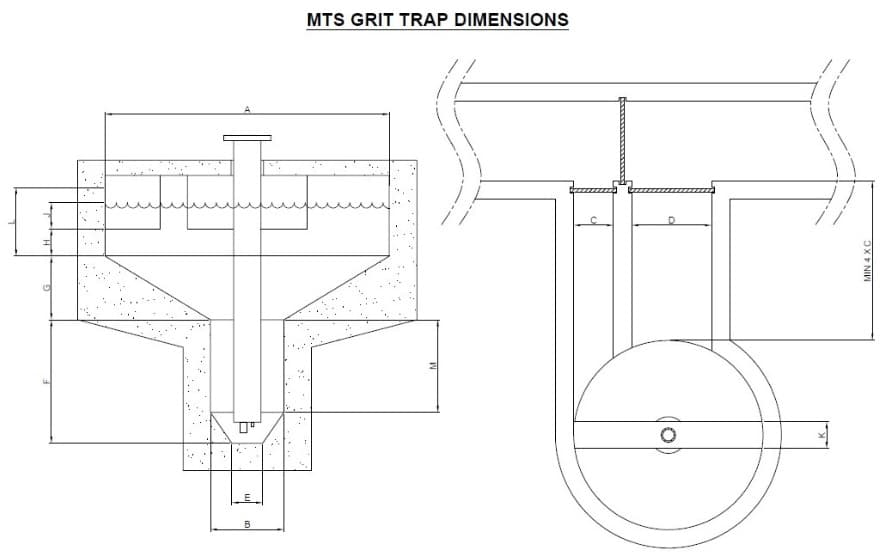
There are two principal types of grit removal equipment used in modern wastewater treatment. The conventional detritor is a circular tank with a centrally driven rotating scraper mechanism that creates a controlled horizontal velocity in the tank. At the design velocity (typically 0.3 m/s), grit settles to the tank floor while lighter organic solids remain in suspension and are carried out with the overflow. A rake/screw classifier mechanism collects the settled grit, washes it to remove entrained organics, and discharges it via a chute for disposal.
The vortex grit separator (also called a vortex grit chamber) is a compact, circular concrete tank in which incoming wastewater enters tangentially, creating a rotating flow pattern. The centrifugal motion drives grit particles outward and downward into a collection hopper while an impeller maintains the vortex and prevents organic solids from settling. Vortex separators offer a smaller footprint than conventional detritors for the same flow capacity, and are available in modular sizes handling 4 to 425 MLD. Both systems target grit particles larger than 0.15 mm in diameter at design flow rates.
Process
How Grit Removal Systems Work
Screened Wastewater Inlet
Bar-screened wastewater enters the grit chamber after preliminary screening. The inlet is designed to distribute flow uniformly across the chamber cross-section for the detritor type, or tangentially for the vortex type.
Controlled Velocity Settling (Detritor)
In the detritor, a rotating paddle or impeller maintains a constant horizontal flow velocity (approximately 0.3 m/s) across the tank. At this velocity, grit particles (specific gravity ~2.65) settle rapidly to the tank floor, while lighter organic particles remain in suspension.
Centrifugal Separation (Vortex Type)
In the vortex separator, tangential inflow creates a rotating vortex. Centrifugal force propels the denser grit particles outward and downward into the conical collection hopper, while lighter organic solids are directed upward and outward with the overflow.
Grit Collection Mechanism
In the detritor, a centrally driven rotating scraper blade sweeps settled grit to classifier openings at the tank bottom. A reciprocating rake or screw conveyor in the classifier elevates the grit while washing out organic material with a water jet or return pump.
Grit Washing & Classification
The classifier mechanism separates washed, clean grit from the organic-rich liquor. The organic liquor (organic return) is recirculated back to the inlet of the grit tank to prevent loss of biological oxygen demand from the treatment process.
Grit Disposal
Washed grit is discharged via a chute into a grit skip or container. Clean, dewatered grit (organic content typically <5%) is suitable for landfill disposal or may be used as fill material. The grit handling system minimises odour and contamination at the point of disposal.
Benefits
Key Advantages
- Protects downstream pumps, pipelines, aeration diffusers, and biological reactors from abrasive wear and accumulation
- Conventional detritor design reliably removes grit particles >0.15 mm at design flow
- Vortex grit separator offers compact footprint — significantly smaller than equivalent conventional detritor
- Integrated grit washing classifier separates organics from grit, reducing disposal volumes and odours
- Organic return mechanism recirculates entrained BOD back to the treatment process
- Centrally driven bridge-mounted mechanism for easy access and maintenance
- Carbon steel construction with protective coatings for standard service; stainless steel available for industrial effluents
- Sizes available from 1.5 m to 16 m diameter (detritor) and 4 to 425 MLD flow range (vortex type)
- Automated operation with low energy consumption and minimal operator attention required
- Extends service life of downstream mechanical and biological equipment by preventing grit accumulation
Applications
Industries & Use Cases
Get a Quote or Technical Consultation
Our engineers can help you select the right grit removal systems configuration for your application.