
Flash Mixer & Pipe Flocculator
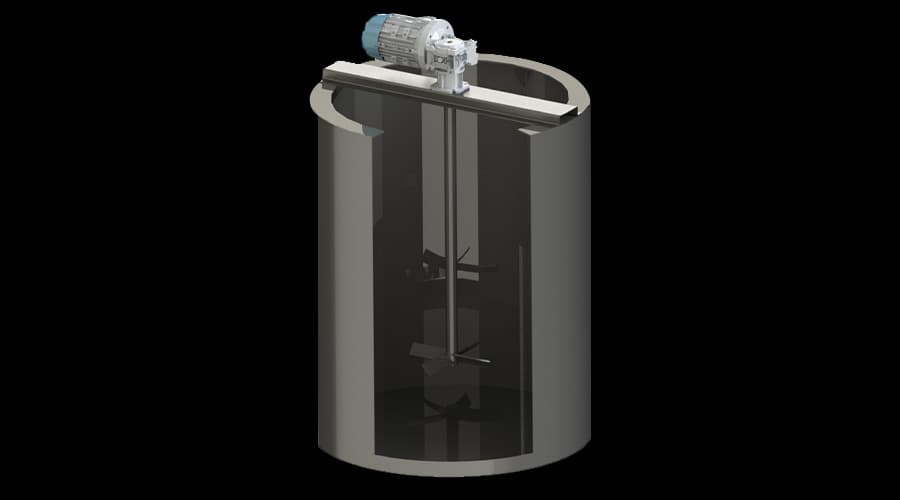
Plug-flow turbulent mixing reactors for rapid coagulation, flocculation, pH control, and precipitation — plus motorized agitators for chemical treatment tanks; no moving parts for pipe reactor, 0.5–25 HP range for mechanical agitators
Overview
About Flash Mixer & Pipe Flocculator
Flash mixing and pipe flocculation are chemical pre-treatment processes that precede solid-liquid separation units such as dissolved air flotation (DAF) systems, conventional clarifiers, and lamella clarifiers. Effective chemical mixing is critical to the performance of downstream separation: coagulants must be rapidly and uniformly dispersed throughout the water column within milliseconds of dosing, while flocculants require a gentler, more prolonged mixing environment to build large, strong flocs without shear destruction.
A pipe flocculator is a plug-flow reactor — a length of pipe through which wastewater flows at a controlled velocity. Turbulence within the pipe, induced by the flow velocity and optional static mixing elements, achieves rapid chemical dispersion without any mechanical moving parts. Chemical injection ports are located at precisely calculated positions along the pipe to allow each reagent to react for the correct duration before the next chemical is introduced. Typical chemical sequences include coagulant injection (rapid dispersion zone), followed by flocculant addition (slow-build floc zone), followed by pH adjustment if needed.
The absence of mechanical moving parts is a key advantage of pipe flocculators over conventional agitated flash mix tanks: there are no impellers to maintain, no seals to fail, and no gearboxes to service. The system operates using only the energy in the flowing water. Multiple sampling and dosing ports (typically up to 4 each) allow on-site optimisation of chemical dosing points and dosages without modifying the pipe structure. Materials of construction — mild steel, stainless steel, or high-density polyethylene — are selected based on chemical compatibility and site corrosion conditions.
Process
How Flash Mixing & Pipe Flocculation Works
Coagulant Rapid Mix
Raw or pre-screened wastewater enters the pipe reactor. Coagulant (typically aluminium sulphate, ferric chloride, or polyaluminium chloride) is injected at the first dosing port, where the high turbulence energy of the flowing water rapidly disperses it through the entire water volume within a fraction of a second — the critical requirement for effective charge neutralisation.
Coagulation Reaction Zone
As water travels along the first section of pipe, the destabilised colloidal particles begin to form microflocs. The pipe length and diameter are sized to provide the correct G (velocity gradient) value and contact time — typically 20–60 seconds — for complete primary coagulation.
pH Adjustment (if required)
If the wastewater pH requires adjustment for optimal coagulation or for the downstream process, acid or alkali can be dosed at an intermediate port. The plug-flow nature of the pipe ensures the adjustment reagent contacts the water uniformly without back-mixing.
Flocculant Addition
Polymer flocculant is injected at a downstream port, in a pipe section with a lower velocity and gentler G value. The flocculant bridges and aggregates the microflocs formed in the coagulation zone, building large, robust macroflocs that settle or float efficiently in the downstream separation unit.
Floc Growth Zone
The final section of the pipe reactor is designed with a reduced velocity or wider diameter to provide a gentle mixing environment where flocs grow without being shear-damaged. By the time the conditioned water exits the pipe reactor and enters the DAF or clarifier, flocs are fully developed and ready for rapid separation.
Benefits
Key Advantages
- No moving parts — zero mechanical maintenance requirement in the mixing and flocculation zones
- Plug-flow reactor design ensures precise chemical contact times and prevents short-circuiting
- Multiple dosing points (up to 4 each for sampling and dosing) for on-site optimisation without modification
- Eliminates the need for large, agitated flash mix tanks — smaller footprint and lower civil cost
- Material options (mild steel, stainless steel, HDPE) selected for chemical and corrosion compatibility
- Integrates directly with DAF systems: no additional energy input required when using DAF recycle pressure
- Consistent chemical dispersion improves downstream clarifier or DAF separation efficiency
- Handles coagulation, flocculation, pH control, precipitation, and demulsification in a single in-line unit
- Suitable for both potable water treatment and industrial or municipal wastewater applications
- Low energy consumption — uses only the hydraulic energy of the flowing process stream
Applications
Industries & Use Cases
Explore More
Related Products
Get a Quote or Technical Consultation
Our engineers can help you select the right flash mixer & pipe flocculator configuration for your application.