
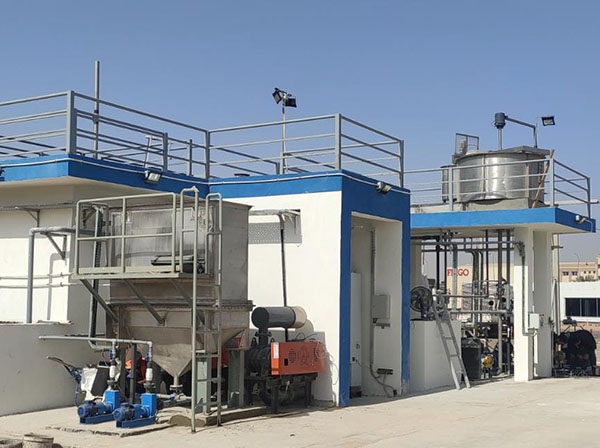
Every day, thousands of Indian factories generate ETP sludge and most of them are confused about what they are supposed to do with it. The confusion is understandable. The Hazardous Waste Rules are complex, the SPCB consent conditions are often vague, and the consequences of getting it wrong — a show-cause notice, a shutdown order — are severe enough that plant managers tend to freeze rather than act.
This guide cuts through the regulatory language and tells you what the rules actually require for ETP sludge disposal in India, what the options are, what they cost, and — critically — what SPCB inspectors are looking for when they visit your plant. If you are running an industrial ETP and your sludge disposal documentation is not current, this is the article to read first.
Hazardous vs. Non-Hazardous: The Critical First Question
The first thing to determine about your ETP sludge is whether it is hazardous waste under the Hazardous and Other Wastes (Management and Transboundary Movement) Rules, 2016 (HWM Rules). This matters because hazardous sludge has far more stringent disposal requirements, more documentation requirements, and significantly higher disposal costs.
Sludge is hazardous if it: (a) appears in Schedule I of the HWM Rules as a process-specific waste stream, (b) exhibits a hazardous characteristic (ignitability, corrosivity, reactivity, or toxicity by TCLP test), or (c) contains Schedule II substances above the specified concentration thresholds.
Do not assume. Many food plant managers assume their sludge is non-hazardous because they are processing food. This is sometimes correct but not always. CIP chemicals, sanitizers, boiler water treatment chemicals, and certain preservatives can introduce hazardous characteristics. Get a TCLP (Toxicity Characteristic Leaching Procedure) test done on a representative sample at a NABL-accredited laboratory before deciding your disposal route.
Schedule I Categories That Catch ETPs
Schedule I lists 28 broad waste categories. The ones most likely to catch industrial ETP sludge:
- Category 28.1 — ETP sludge from chemical and allied industries: This catches ETPs at pharma plants, specialty chemical manufacturers, and agrochemical units. If your plant manufactures chemicals (including surfactants, dyes, or intermediates), your ETP sludge is presumptively Schedule I.
- Category 5.1 — Spent acids: If your ETP neutralizes strong acid streams from metal cleaning or plating operations, the sludge from the neutralization step may be Schedule I.
- Category 16.1 — Waste from leather tanning: ETP sludge from tanneries is hazardous due to chromium content. TCLP leachate for Cr(VI) must be below 5 mg/L; tannery ETP sludge almost always exceeds this.
- Category 22.1 — ETP sludge from electroplating: Contains heavy metals (Ni, Cr, Cu, Zn) at concentrations that will fail TCLP. Always hazardous.
If you are a food, dairy, or beverage manufacturer with no heavy metals in your process and no halogenated chemicals in your CIP, your sludge is likely non-hazardous. But verify this with TCLP testing at least once; SPCB inspectors increasingly ask for this report.
Form 2 Manifests: What You Actually Need
Form 2 is the hazardous waste manifest under Schedule V of the HWM Rules. It is a 7-copy document that must accompany every movement of hazardous waste from your facility to the authorized TSDF or recycler. This is not optional and not a formality — your SPCB authorization will specifically require you to maintain a manifest register.
What you must maintain in your manifest register:
- One copy of every Form 2 issued (the generator copy)
- Signed acknowledgment from the TSDF that the waste was received (Copy 7)
- Transporter's copy showing the approved vehicle number and driver details
- Annual returns to the SPCB summarizing total waste generated, sent for disposal, and current stock
The manifest register must be maintained for a minimum of 5 years and must be available for inspection. A missing manifest for even a single consignment is grounds for a show-cause notice. Maintain a physical register and a digital backup.
Non-hazardous sludge does not require a Form 2 manifest but should still be disposed of with a delivery receipt or weighment slip to demonstrate chain of custody. SPCB inspectors are increasingly asking to see disposal records for non-hazardous sludge as well.
TSDF Facilities in India: Where and What They Cost
There are approximately 40-50 authorized TSDF facilities operating across India, concentrated in industrial states. Major facilities:
- Maharashtra: MWML (Maharashtra Enviro Power) at Taloja and Butibori; GEPIL at Talegaon
- Gujarat: GEPIL (Gujarat Enviro Protection) at Ankleshwar; Ramky Enviro at Vatva
- Tamil Nadu: TNPL-managed facilities; private TSDF at Gummidipoondi
- Punjab / Haryana: Ramky Enviro at Kundli; limited capacity
- Uttar Pradesh: UEPPCB-approved TSDF at Hapur and Agra
Typical disposal costs (2025-2026 rates, excluding transport):
- Secured landfill (inertized, Schedule I hazardous): ₹5,000-9,000 per MT
- Incineration (halogenated organics, high-calorific waste): ₹12,000-25,000 per MT
- Co-processing in cement kiln: ₹2,500-4,500 per MT depending on CV
- Authorized recycler (metal recovery from electroplating sludge): ₹1,000-3,000 per MT
Transport is typically ₹15-30 per km per MT in an authorized hazardous waste transporter vehicle. Distance to the nearest TSDF is a significant cost factor. For plants in Pune, the TSDF at Taloja is about 160 km — adding ₹3,200-4,800 per tonne for transport on top of disposal fees.
Non-Hazardous Sludge Options
If your sludge is confirmed non-hazardous, you have more cost-effective options:
Composting: The best option for food and dairy ETP sludge with high organic content. Co-compost with agricultural waste (paddy husk, sugarcane bagasse) at a ratio of 2:1 carbon:nitrogen. Final compost must meet FCO 1985 standards if sold. Cost: ₹300-800 per MT (you are paying for transport to the composting facility or operating a small composting yard on-site). Some composting facilities will collect sludge at no charge if the quality is good.
Brick kilns: Brick kilns in many states accept non-hazardous sludge at low moisture content (<40%) as a clay substitute. Calorific value needs to be below 2,500 kcal/kg (sludge with high fat content may be too calorific). Rates: ₹200-500 per MT. Requires a tie-up with an authorized brick kiln and documentation of the arrangement.
Land application: Permitted under certain conditions for agricultural land application of treated sludge meeting soil amendment standards. Requires SPCB approval and monitoring. Practical for large rural industrial plants with nearby agricultural land. Not feasible for most urban industrial estates.
Co-Processing in Cement Kilns
Co-processing is increasingly the preferred disposal route for industrial ETP sludge — both hazardous and non-hazardous — in India. Cement kilns operate at 1,400-1,450°C with long residence times, which destroys organic pollutants and permanently immobilizes heavy metals in the clinker matrix.
CPCB issued guidelines for co-processing in 2010 and updated them in 2022. Under these guidelines, sludge with calorific value above 1,500 kcal/kg and appropriate heavy metal concentrations can be used as an alternative fuel and raw material (AFR) in cement kilns. The cement manufacturer must have an authorization for co-processing and must submit trial burn results to the SPCB.
Major cement companies with active co-processing programmes in India include UltraTech, ACC, Ambuja, and Shree Cement. They typically accept ETP sludge through authorized AFR suppliers. Your sludge needs to meet their specifications: moisture below 30%, chloride below 0.1%, heavy metals within limits.
Cost of co-processing is lower than TSDF landfill — typically ₹2,500-4,500 per MT — and it is increasingly accepted by SPCB as a compliant disposal route for many Schedule I sludge categories. Get written confirmation from your SPCB that co-processing is acceptable for your specific sludge category before committing to this route.
What SPCB Inspectors Actually Check
SPCB inspections for sludge compliance typically focus on four things. Know what they look for so you are not caught unprepared.
1. Manifest records: They will ask for your manifest register for the past 12 months. Every consignment of hazardous waste that left your facility must have a Form 2 with the TSDF acknowledgment copy. Gaps in the register — months where sludge was generated but no manifests are filed — are the most common finding and the most common basis for show-cause notices.
2. Annual returns: Annual returns must be filed with the SPCB (typically by 31 January for the previous year) showing total hazardous waste generated, disposed, and in storage. Missing annual returns are a serious compliance failure.
3. Sludge storage: Inspectors physically check the sludge storage area. Hazardous sludge must be stored in labeled, covered, impermeable containers or in a covered, impermeable-floor storage area. Maximum storage period on-site is 90 days without specific authorization. Open sludge pits, unlined sludge ponds, or sludge stored in open drums outside are immediate violation findings.
4. Authorized transporter: Hazardous waste must be transported by a transporter authorized by the SPCB. They may ask for the authorization certificate of the transporter who moved your last sludge consignment. Using an unauthorized transporter (a regular dumper truck) for hazardous waste is an additional violation.
The one thing inspectors rarely check thoroughly is whether the sludge actually reaches the TSDF, beyond looking at your paperwork. This is why manifest compliance (getting the Form 2 acknowledgments back from the TSDF) is so important — it is your evidence that the sludge was properly disposed of.
Need help with sludge disposal compliance?
Spans Envirotech has helped dozens of industrial plants establish compliant sludge characterization, manifest documentation, and TSDF tie-ups across India. Contact us for a compliance review and disposal plan specific to your sludge.
Request a free proposal →