Dissolved Air Flotation (DAF)
Physio-chemical solid-liquid separation using pressurised micro-bubbles — removing suspended solids, oils, fats, and grease from industrial and municipal wastewater at 5 to over 1,000 m³/hr
Overview
About Dissolved Air Flotation (DAF)
Dissolved Air Flotation (DAF) is a physio-chemical water treatment process that separates suspended solids, fats, oils, and grease (FOG) from wastewater by attaching fine micro-bubbles to contaminant particles, causing them to float to the surface for mechanical removal. DAF is widely deployed as a primary clarification stage ahead of biological treatment, as a secondary clarifier for reducing colour and turbidity, and as a sludge thickener in municipal sewage treatment plants.
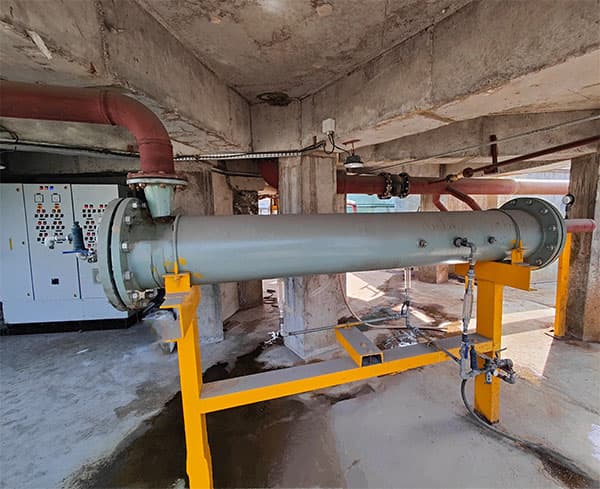
The core of a DAF system is an Air Dissolving Tube (ADT) or pressurisation vessel in which air is dissolved into a recycle stream of treated water under pressure, typically 4–6 bar. When this saturated stream is released into the atmospheric-pressure flotation tank, the dissolved air comes out of solution as countless micro-bubbles measuring 10–100 microns in diameter. These bubbles attach to suspended particles, reducing their effective density and causing them to rise rapidly to the water surface as a floating sludge blanket, which is continuously removed by surface scrapers or paddles.
Chemical dosing — coagulants and flocculants — is integrated upstream of the DAF unit to destabilise colloidal particles and form larger, more buoyant flocs. This chemical pre-treatment significantly improves TSS and FOG removal efficiency, enabling DAF systems to handle highly variable and high-strength industrial effluents. Heavier solids that do not float settle to the tank bottom and are periodically purged as bottom sludge.
DAF units are available in rectangular and circular tank configurations to suit site constraints, and can be engineered for capacities from 5 m³/hr to over 1,000 m³/hr per unit. Clarified water exits from mid-tank outlet nozzles, suitable for discharge, reuse, or further biological treatment.
Process
How Dissolved Air Flotation Works
Chemical Pre-treatment
Coagulant is dosed into the raw influent to destabilise charged colloidal particles, followed by flocculant addition to aggregate fine solids into larger, more easily removed flocs. Chemical mixing is achieved in a flash mixer or pipe flocculator upstream of the DAF tank.
Air Dissolution Under Pressure
A portion of clarified effluent (recycle stream) is pumped through an Air Dissolving Tube (ADT) at 4–6 bar where air is forced into solution. Saturation in the ADT is typically achieved in under 15 seconds, producing a highly air-saturated recycle stream.
Micro-Bubble Release & Particle Attachment
The pressurised recycle stream is released into the flotation tank through release nozzles at atmospheric pressure. Dissolved air instantly nucleates into millions of micro-bubbles (10–100 microns) that attach to floc particles, oils, and suspended solids, dramatically reducing their density.
Flotation & Surface Scum Removal
Buoyant particle-bubble aggregates rise rapidly to the water surface, forming a consolidated floating sludge blanket. Motorised surface scrapers or rotating paddles continuously skim this scum layer into a collection trough for thickening or disposal.
Bottom Sludge Purge
Heavier inorganic solids or dense particles that do not float settle to the conical or flat tank bottom. These are periodically purged through bottom valves or a sludge pump, keeping the flotation zone clear.
Clarified Water Collection
Treated water, now substantially free of suspended solids and FOG, exits through mid-tank outlet nozzles at a controlled weir level. The clarified effluent proceeds to biological treatment, further polishing, or direct reuse depending on quality requirements.
Benefits
Key Advantages
- Highly effective removal of suspended solids, fats, oils, and grease (FOG) in a single compact unit
- Handles wide flow range: 5 m³/hr to over 1,000 m³/hr per unit
- Short hydraulic retention time (15–30 minutes) compared to gravity clarifiers, reducing footprint
- Effective as both primary clarifier and secondary colour/turbidity polishing stage
- Applicable as a sludge thickener to concentrate biological sludge before dewatering
- Chemical dosing integration enables treatment of highly variable and high-strength industrial effluents
- Rectangular and circular configurations available to suit different site layouts
- Consistent performance across fluctuating influent loads with chemical dosage control
- Lower sludge volume produced compared to conventional settling due to drier skimmed sludge
- Suitable for industries where gravity settling is ineffective for light particles and emulsified oils
Applications
Industries & Use Cases
Get a Quote or Technical Consultation
Our engineers can help you select the right dissolved air flotation (daf) configuration for your application.
Free Chemical Dosing Calculator
Estimate coagulant and flocculant dosing requirements for your DAF system.