
API Oil-Water Separator
Gravity-based primary separation of free-floating oil and suspended solids from industrial wastewater — designed per API Standard 421 for refineries, petrochemical plants, and power facilities
Overview
About API Oil-Water Separator
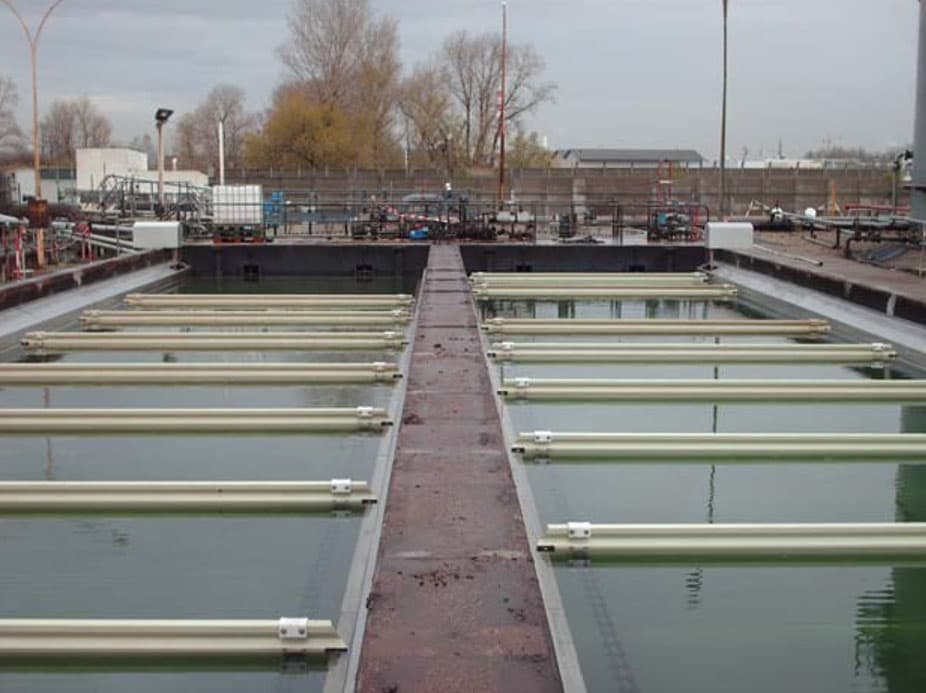
An API (American Petroleum Institute) oil-water separator is a gravity-based primary treatment unit that removes free-floating oil, grease, and settleable solids from industrial wastewater before it proceeds to secondary treatment or discharge. Designed in accordance with API Standard 421 (formerly API Publication 421), the separator exploits the natural density difference between oil (specific gravity <1.0) and water to achieve separation without any chemical addition or moving parts in the separation zone.
The separator is specifically effective for free oil with droplet sizes of 150 microns and larger. Oil droplets smaller than this may require secondary treatment with a CPI/TPI corrugated plate interceptor or dissolved air flotation (DAF) system to meet discharge standards. For refineries and petrochemical facilities, API separators serve as the essential first stage in a multi-step wastewater treatment sequence, protecting downstream biological treatment systems from hydrocarbon overloading.
The separator is designed for the specific flow rate, oil content, temperature, and wastewater characteristics of each facility. Key sizing parameters include the horizontal flow velocity (maintained below the oil droplet rise velocity), the oil-to-water density differential, and the required separation efficiency. Units can be constructed in concrete with steel internals or as fully steel-fabricated modular systems, and can be covered to contain vapour emissions and odours.
Process
How an API Oil-Water Separator Works
Wastewater Inlet
Oily wastewater enters the separator through an inlet diffuser or baffle that spreads the flow evenly across the full tank cross-section, minimising turbulence and preventing short-circuiting.
Internal Baffles & Flow Distribution
Strategically placed internal baffles direct flow through the separator, extending the effective residence time and providing a quiescent zone where oil and solids can separate from the water column under gravity.
Oil Rise & Coalescence
Free oil droplets (≥150 microns) rise to the water surface due to buoyancy. As droplets rise and contact the surface, they coalesce into a continuous oil layer. The horizontal flow velocity is kept low enough that rising oil droplets reach the surface before reaching the outlet.
Oil Skimming
A floating weir or motorised paddle skimmer continuously removes accumulated surface oil into a dedicated oil collection chamber or sump. The collected oil can be recovered for recycling, reprocessing, or proper disposal.
Sludge Settling
Denser solids — sand, scale, and sludge — settle to the sloped or flat tank bottom, accumulating in a sludge chamber from which they are periodically removed by pumping or scraper mechanism.
Clarified Water Outlet
Treated water — with free oil substantially removed — exits through a submerged outlet or adjustable weir at the effluent end. The clarified water typically proceeds to a CPI/TPI separator, DAF unit, or biological treatment system for further treatment.
Benefits
Key Advantages
- Removes free-floating oil ≥150 microns without chemicals or energy-intensive equipment
- Designed per API Standard 421 — internationally recognised benchmark for oil-water separation
- Protects downstream biological treatment systems from hydrocarbon shock loads
- Simple, robust construction with minimal moving parts — low maintenance requirements
- Long operational life — civil construction with steel internals can last decades
- Effective oil recovery enables reuse or cost-effective disposal of separated hydrocarbons
- Modular and custom civil designs to match site-specific flow rates and footprint constraints
- Covereable design contains vapour emissions and minimises odour impact
- Handles high flow rates typical of refinery and petrochemical wastewater streams
- First-stage treatment upstream of CPI/TPI separators or DAF for comprehensive oil removal
Applications
Industries & Use Cases
Get a Quote or Technical Consultation
Our engineers can help you select the right api oil-water separator configuration for your application.